Sunday, February 21, 2010

Morocco - a sensory extravaganza!

Hi all

A long overdue note on our holiday over the Christmas period, which we spent in Morocco. Not exactly a hotbed of Christmas festivities, however a welcome break from the UK's icy winter and an amazing country full of interesting sights, sounds, smells and tastes which delivered a fantastic experience for us.

Marrakesh - Merry Christmas!

Although we would be exploring Morocco as part of a small tour group, Michelle and I added a couple of extra days onto our trip and visited Marrakesh. Marrakesh is towards the south of Morocco and is the easily the most popular destination for tourism. Notwithstanding this, it retains a real charm and an interesting sight or smell lurks around every corner of its winding old city streets.

Arriving in the evening we headed out to orientate ourselves with the city. Soon enough we found the main square - a huge market packed in the evening with makeshift market restaurants touting freshly cooked Moroccan goodies. Off to the side of the square literally thousands of people, mainly Moroccan, gather and watch singers, dancers, old story tellers (some complete with their own live owl), palm readers and the occasional snake charmer. A baptism of fire for us perhaps, but the whole place had great feel to it and we were excited about what lay ahead.


We had a fantastic Christmas day, the highlight being a half day cooking class at La Maison Arabe (http://www.lamaisonarabe.com/uk_content/ateliers-cuisine.php). Along with another young couple, 'Howard' a Moroccan chef who had worked all over the world, took us through how to make a traditional Chicken, lemon and black olive tagine. We also made a char grilled vegetable salsa and a delicious dessert using filo pastry and a rose flavoured custard like mix. The tagine was incredible - the best we had the whole trip (and that's not just because we're biased!?). On a return visit the restaurant where the cooking school is we were reunited with Howard who somehow convinced us to pay double the going rate for a used tagine - but it came highly recommended and is apparently 'top quality'. Hmm. Anyway - it was good buy as we have recreated the meal in said tagine back in London and it was a delicious as ever!


The rest of our time in Marrakesh was spent exploring its markets and sights - including a great self guided walking tour of the city markets (but more on Morocco's markets below). We did also treat ourselves to an upmarket hamman (steam bath and sea salt scrub) followed by an hour full body massage - interspersed with copious quantities of mint tea and lazing around in beautifully scented darkened rooms. What a bugger of a life eh?

Casablanca - I guess the tour had to start somewhere?

We took a train north to Casablanca where we joined our tour group - another Kiwi, 3 Aussies, a US couple, a Canadian and our guide - a Moroccan whose passion was trekking and mountain guiding, but who was very knowledgeable on each of the cities our trip would take us to.

We were underwhelmed by Casablanca - it was a fairly run down place, modern in contrast to Marrakesh and it felt quite rough around the edges. Interestingly, it is quite well known for its art deco influenced architecture - a blend of French colonial design and traditional Moroccan.

The one thing Casablanca is worth visiting for is its massive mosque (the Hassan II Mosque) located right on the sea shore. Built under orders of King Hassan II this mosque can hold 25,000 worshippers inside, with space for a further 80,000 in the surrounding squares and courtyards. Opened in 1993 it has some high tech features - heated floors, a huge retractable roof and a 210m minaret which shines a laser beam towards Mecca in the evenings. King Hassan's dream was to create a place of pilgrimage in Morocco. It is one of the very few Islamic religious buildings open to non-Muslims, one example of Morocco's relatively moderate position in the Islamic world for which it prides itself. The building and the massive hammam (washing) complex underneath it was quite spectacular.

Rabat

Next stop on our tour of the 'imperial cities' was Rabat - the current day seat of Moroccan administration and permanent home of the King (although he has numerous enormous palaces dotted around the country).

Highlights here were:
  • The Chellah - now abandoned and overgrown, these ruins mark an ancient Roman city (taken over by storks when the Romans moved on). It was peaceful spot and overlooked the fertile riverbed below (which was in part the reason it was chosen by the Romans). The storks were interesting - especially since we'd last seen storks in Alsace - which seemed a million miles away from Morocco in all respects!? Last stop at the Chellah was a walled pool which attracts woman from far away who come here armed with hard boiled eggs to feed the resident eels - it is said to bring fertility. Michelle seemed to loiter here - but I am trying not to read too much into that....
  • We also visited Kasbah des Oudaias here - it is the oldest inhabited part of the city and is perched on the cliff overlooking the bay below. It has narrow winding lanes and the buildings are uniformly painted white, with a blue strip about from the group about 2m up the wall - said to help deter mosquitoes. A great spot for a mint tea (although we didn't have time for this!?).
En-route to Fes

Our trip from Rabat to Fes was memorable - thanks mainly to interesting stops at Meknes and Volubilis.

Meknes was an imperial city in the 17th century and was a nice, relatively peaceful place. Our local guide was a wealth of knowledge on the sites we visited -which included an immense ancient grain storage facility (which could stable and contain food for 12,000 horses and had underground water channels to maintain its cool temperature) and an underground prison where huge armies of prisoners and slaves were kept. We also visited a old religious school here - the architecture and design of which was reminiscent of the Alhambra in Spain.

Volubilis appears from nowhere in the countryside. It is the site of an ancient provincial Roman capital - a distant outpost of the Roman Empire. It was one of the highlights of the trip. Here we could see Roman olive presses and the original mosaic floors of stately homes. The colours and quality of the mosaics all these years on was incredible - exotic animals, dolphins, Bacchus and more were clearly visible in these huge pieces of art, originally designed more with a functional purpose in mind. Quite incredible - and relatively untouched with the mosaics etc all exposed to the elements.
Fes - a shopper's paradise

Throughout our trip we had heard that the artisans of Fes were without comparison and we were not disappointed by the markets here - which were the best we saw. I resisted the urge to tell you all about Morocco's markets until now - but the markets of each place we visited were always a real feature (perhaps with the exception of Casablanca).

Morocco's markets are like stepping back in time. With narrow bustling lanes you can soon find yourself completely lost in them (as we did on one or more occasions!). The following will be things we never forget:
  • The smell of huge piles of fresh mint and coriander

  • Beautiful sculpted piles of olives or spices - too pretty to touch!

  • The meat markets - live chickens on a death row of sorts, huge cuts of beef hanging, lamb (with testicles still attached) as male lamb commands a premium, not to mention the odd speciality store (apparent by the fresh camel head hanging by them). Shops selling fresh fish and snails were common.


  • Nuts and dried fruit. Huge piles of them wherever you went - the dried figs in particular were devine. Nuts, we discovered, were best purchased in Marrakesh in 'nut alley' a short cut between our Riad and the markets - our salted cashews and pistachios were delicious!

  • Old crafts and industry continuing to this day - blacksmiths working red hot iron from fires and tailors sitting behind ancient Singer sewing machines.

  • Leather - the stink of the pits where workers cure and dye animal skins in a liquid mix of animal urine and bird droppings (among other things?!). The colours here though were incredible - pity the guys pushing leather goods are so pushy.

  • Speaking of pushy - carpets! Dave Dobbyn happened to have visited a carpet store we visited and being a Kiwi who had shown just a little too much interest (while making it clear I was not there to buy) I soon found myself in a one sided negotiation with the seller starting his price for a carpet at €1,500, but talking himself down to €400 by the time I left (I was still not tempted). It was the deal the century - I wouldn't be able to sleep if I passed it up he told me. Strangely enough I slept fine that night.....


  • Donkeys - laden with goods or pulling their owner on a trailer work through the markets' narrow lanes.

We also visited a ceramic factory here, were we started our binge of buying the brightly coloured ceramic wood fired plates, bowls and tagines on offer in Fes.

From Fes we also visited Sefrou, a Berber township about 30kms away on the edge of the Middle Atlas mountains. If anywhere felt like going back in time, it was this place. Merchants selling dried herbs to cure any aliment and very little sign of technology anywhere. We happened to be there on market day - so fresh produce was everywhere, as were freshly harvested olives in sacks on heavily laden utes - produce of that year's harvest - Morocco is about the 7th largest producer of olive oil in the world!

New Years Eve was also spent in Fes. We had a great night - following Moroccan tradition of watching a sort of talent show before the night descended into dancing with a group of local women and their younger sons. There wasn't much alcohol floating round - but with a shisha and good dancing and a few sneaky drinks we had a hilarious night.

Full circle - back in Marrakesh

Our trip which had taken us from the north and worked back down the country finished (after a long drive on New Year's day) to Marrakesh. We were like locals here and spent the next couple of days exploring the city more and finishing off any last minute shopping tasks!?

All in all - a magic trip. With obvious similarities to Egypt, what Morocco may lack in terms of ancient ruins etc, it more than makes up for with its beautiful cities, incredible markets (which leave Egypt's for dead!), friendly people and tasty cuisine.

Sunday, December 20, 2009

South Africa - Something for Everyone


Our big 2 week holiday had been much anticipated, but with a busy lead up to departure I left with little clue about what lay ahead (Mich: as per usual). I knew there would be some 'game park' action, some driving, good steaks, nice wine and plenty of time on the coast - the details however were less clear to me. Fortunately for me others had it all in hand (thanks Rich/Sel).


For those of you who are just here to look at the pics, I'll summarise: we had an incredible holiday which offered a little bit of something for everyone and which far exceeded expectations. South Africa has so much to offer and I can see us returning some day to experience more of it.


Kruger National Park - 'Big 5 hunting'


Rich (our host) greeted us at Jo'burg in a large white people mover that would be 'home' for the next 4 days in Kruger (a few hours north). Stocked with food and liquid we were set for some Big 5 hunting! The next few days would be spent getting up to be on the road at 4:30a.m. (Kasabian's 'Fire' will never be the same again), driving around the park in search of game, birds (yawn), not to mention antelope (last but not least Rich).


Highlights:
  • By 1pm on Day 1 in the park we had 'ticked off' the Big 5: lion (3 females in the undergrowth on the side of a road), rhino (Mum, Dad and a baby on the road), water buffalo (a huge herd crossing the road around us), elephant (just off the side of the road) and leopard (on a kill about 20ms off the road). Job done. 5 shots required (whose idea was that?) - this Big 5 hunting is a piece of cake.


  • Sitting in the car next to (about 5m away) 3 male lion on a zebra kill while 17 hyena surrounded them and our car in the hope of a tasty snack. The lion were not backing off one bit and while the highly agitated hyena waited they decided to snack on our car - partially tearing the number plate off (try explaining that one to the rental agency?).

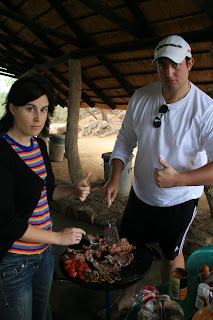
  • Brai'ing (the activity formally known as BBQ'ing). We were staying in one of the camps in the park in a self contained cabin. South Africans don't believe in the gas BBQ and so we watched and learned as Rich got the wood/coal fired brai going each night with great results (especially the butternut pumpkin done in the embers... yum!).


  • All the sights. We were incredibly lucky with what we saw (partly we think due to the unseasonably cold weather). To list just a few of the sights: leopard in a tree (some of you may have heard about this already as Sel announced the sight at volume that could easily be heard cross border), elephant knocking a large tree over to get to the roots, lots of hippos including some out of the water, baby giraffes, warthogs, crocs, jackal, all of the the Big 5 numerous times (more shots? whose idea was that?), lots of birds and countless antelope - including the very rare sable antelope.

  • Sleeping co-drivers (and driver), dissent from the backseat re: antelope, deep fried eggs for breakfast, good times with Gareth (or was it Grant, or Wayne or Graeme?), scenarios in the public toilets, the strange smell emitting from the boot of car, late night animal walks with chicken bones for props and the battle between photographers for the money shot.

Port Elizabeth to Hermanus

After saying farewell to Rich and Gareth we took a short and very bumpy flight into a stormy Port Elizabeth down on South Africa's southern coast. Here we picked up our white (all cars are in SA) Beemer (I know what you are thinking: tossers) and from here we would spend 4 days driving close to the coast to Hermanus - taking in the Garden Route as we went.

Highlights:
  • Our accommodation in Jefferies Bay (Supertubes B'n'B) - pure luxury with an incredible breakfast. We all enjoyed being back by the coast after being landlocked in London for so long!

  • An evening spent enjoying fresh wild and farmed oysters from the shell at the Knysner Oyster Company as sat in a rustic hut on poles over the water listening to live music, enjoying a drink and watching the sunset. Magic.

  • Exploring Plettenberg Bay - a slightly upmarket but beautiful beachside resort town just east of Knysner.

  • The start of the Otter Trail - a beautiful coastal walk which we did at pace, but which was great. You can do the full walk which is about 4 days (although 2 at our pace) - perhaps next time?
  • Arniston - my favourite of the places we stayed in and a lot like Mahia in its feel. It had great pub down on the seafront where we managed to see the last 10 mins of the ABs beating England before retiring to our accommodation for our first 'solo' brai - which went far better than anticipated.

  • The drive from Arniston to Hermanus - first stopping at a coastal reserve just to the west of Arniston for nice walk out to South Africa's longest uninterrupted stretch of beach. This was followed by an unexpected introduction to the South African wine industry at the Black Oystercatcher winery which we stumbled upon (and out of) en-route to Hermanus and at which we enjoyed a great tasting accompanied by a platter of local produce. Yum!

Hermanus and the wine regions

Our next base was Hermanus, famous for its whale watching, where Rich's family holiday home would be our base for a few days.

Highlights

  • Night one - Fever in Hermanus - Brai on the rooftop deck, catching up on unconsumed Big 5 shots, Kings, Guess the Music, too much time spent in the 'bar', and late night swimming (for those allowed). Goodbye to Rich again - its safest when he's not around anyway?!

  • Walker Bay and Bot River wine regions. Armed with a list of winery recommendations we set off into the nearby valley wine region to taste some beautiful reds (blends, Syrah, Pinot) and whites (Sauvignons, blends and sweets). The highlight was however Beaumont Estate in Bot River. At this family owned winery we were treated to an amazing tasting by the winemaker's wife, right through the whites, reds, sweet wine and even into the port! She took pity on Andrew (whose fever was still subsiding) and invited us to enjoy a swim in the dam on the winery while we enjoyed a chilled bottle of their rose. Probably the best experience we have ever had at a winery and one which for us summed up South Africa's hospitable approach to wine tourism.
  • Whale spotting from the coast in Hermanus - the South African coast is famous for South Right and Humpback whales. During our time in Hermanus we saw plenty - they come in incredibly close to the shore, sometimes gracefully easing through the water, occasionally breaching right out of the water - spectacular!

  • Steak at B's Steakhouse - just one of many beautiful and great value meals we ate.
  • We also had a great day in Franschhoek (a nearby town which sits in another wine region) the highlight of which was an incredible picnic basket which we enjoyed in the winery in warmth of the South African sun. We also took in Elgin, another wine region en-route to Cape Town) - also very nice and where we were made to feel very welcome.

Cape Town - the final leg

With a week and a half under our belts we again imposed ourselves on Rich (and this time his family) in Cape Town. Here we enjoyed a fairly leisurely final few days.

Highlights:

  • A drive down the coast to the Cape of Good Hope Nature Reserve. Spectacular coastal roads, nice short walks, pretty coastal villages along the way. A great way to spend a day.

  • A trip up Table Mountain - right from the ride up this is a breathtaking experience. While warm at the base of the mountain, it was freezing on top - but the panoramic views out over Cape Town and down the coast (where we had driven that day) more than made up for the temperature.

  • Dinner at La Colombe - this is South Africa's best restaurant and happens to be where Rich worked part time behind the bar. We enjoyed a 6 course wine matched tasting menu which was sublime.
  • Constantia - as it happened we were staying in Constantia another wine region! It would have been rude not to check it out - so check it out we did. It is most famous for its sweet wines, with some wineries boasting Napoleon (and now us) amongst their customers.
  • The final supper - appropriately mixing the Brai with seafood (something which although not mentioned much above, was top notch in SA) and a very pleasant evening spent with Rich and family at home. A nice way to finish the trip.

As you can see, we had a fantastic time. It was great travelling with Andrew and Sel again and Rich was the perfect host and guide.


South Africa was a beautiful country. The extremes of poverty and the middle class wealth were marked and it seems will take a long time to bridge the gap. However, it came as a surprise to me how safe I felt as we made our way around the country and almost without exception, people were friendly and helpful.


The climate, scenery, food, wine, people and experiences on offer were fantastic. A taste of the lifestyle has left us looking forward to the return home to NZ even more!

Sunday, November 08, 2009

Alsace in Autumn


Ever since I saw a photo of a small church sitting on top of a hill covered in golden grape vines, I've always wanted to visit Alsace in the autumn. So for four days recently we soaked up the beauty of the Wine Route which runs through this region and all it has to offer with friends, Andrew and Rachael.

The Wine Route is 170kms long and runs along the valley at the foot of the Vosges linking dozens of picturesque historic villages and weaving through the region's wineries. But there is far more to Alsace than its wine - its history and culture a mixture of German and French makes it a fascinating place to visit.


Over the 4 days we explored many of the little villages along the way. Stand out villages were probably Colmar (where we were based for 2 nights), Riquewhir, Eguisheim and Ribeauville. Each village had narrow cobbled streets lined with 'ginger bread' houses all adorned with colourful flowers. Along the streets are little shops, restaurants, wine tasting rooms and people handing out samples of fresh macaroons (for some unknown reason - a local specialty?).

Wine and food forms a key part of the region's appeal and culture - lucky as they were also pretty high up on our agenda! Wines were always tasted along with a suggestion on what they should be paired with - foie gras, the local munster cheese - matching wine and food was very much the done thing here.


The food was really good - and we ate A LOT! The cuisine is a mix of German (sauerkraut, pork hocks, sausages etc) and French (e.g. foie gras, escargot, creme brulee etc). We developed a taste for the tarte flambos - sort of like a pizza and the local pies were also very good - although caution when ordering the latter is recommended as you can easily end up with something quite different to what you are expecting - something we (actually, I) learned the hard way. Not once over the four days did we have a bad meal - a pretty good track record.


It would be wrong not to dabble in the local product. Most famous is the Alsace Riesling, but we soon learned that our soft spot where the rich, spicy and generally fairly sweet Gewurztraminer. Great as an aperitif, with dessert or with foie gras (which is lucky as Michelle consumed the latter almost daily!).


The wine tasting - us and two generations of Mochel winemakers

We did a few tasting along the way - but the stand out for us was a visit on the final day to Domaine Frederic Mochel. This family owned and run estate has been passed from generation to generation since sometime in the 17th century. The son of the current winemaker (a winemaker himself) led us through a great tasting of their Grand Crus - all of which were very nice. He was friendly and informative and even took us for a little tour of their cellar and production area/bottling area.


The drives were very picturesque too. At times we found ourselves weaving through forests of trees coloured rich browns, reds and amber, the ground and road littered with colourful leaves. The Alsatians are an active bunch and the forests apparently their playground for mountain biking, walking and (my favourite) mushrooming! Sometime the forests in the hills felt busier than some of the villages in the valley below! The road would then drop down back into areas planted with grapes - which ranged from being bare, but more commonly were covered in yellow foliage. One day we came across workers harvesting Gewurztraminer for a late harvest sweet wine (called a Vendange Tardive). Next to the workers a bunker leftover from the war sitting nestled in the vines.


The harvest


The bunker was not the only reminder of the wars that have besieged this region in the past. We took a drive up into the Vosges to visit the Natzweiler-Struthof Concentration Camp. This camp was the only camp set up by the German's on French soil, the site chosen so that the workers could quarry nearby valuable pink granite deposits. Although this was not a death camp (there was a gas chamber nearby), many workers were worked to death or killed - between 10,000 to 12,000 are said to have died. It was the first of the camps found by the Americans as they advanced into Germany - so their first real insight to the treatment of the prisoners by the Nazis.

Site of the concentration camp

Outside the camp there is a very modern museum which provides a more general history of WWII and the various concentration camps that were established. What struck me most about the camp was that it seemed so contradictory to have such an awful camp situated in such a beautiful location. A travel writer summed it up nicely when he wrote "On a slope where normal people might have built a holiday complex, the Nazis established a concentration camp".


We had a great experience in Alsace - although it should be visited in small doses - I am sure we all packed on a fair bit of weight even in a short trip like ours!

Alsatian beer marketing - 'Sans Coulotte'